Veuillez entrer au moins 2 caractères pour effectuer une recherche.
Veuillez entrer au moins 2 caractères pour effectuer une recherche.

Gardiens du Mémorial(2)
Ces Gardiens gèrent ce mémorial. Contacter ou rejoindre


Robert "Dr. Bob" Floyd Ezell, MD
1937 - 2026
1937 - 2026
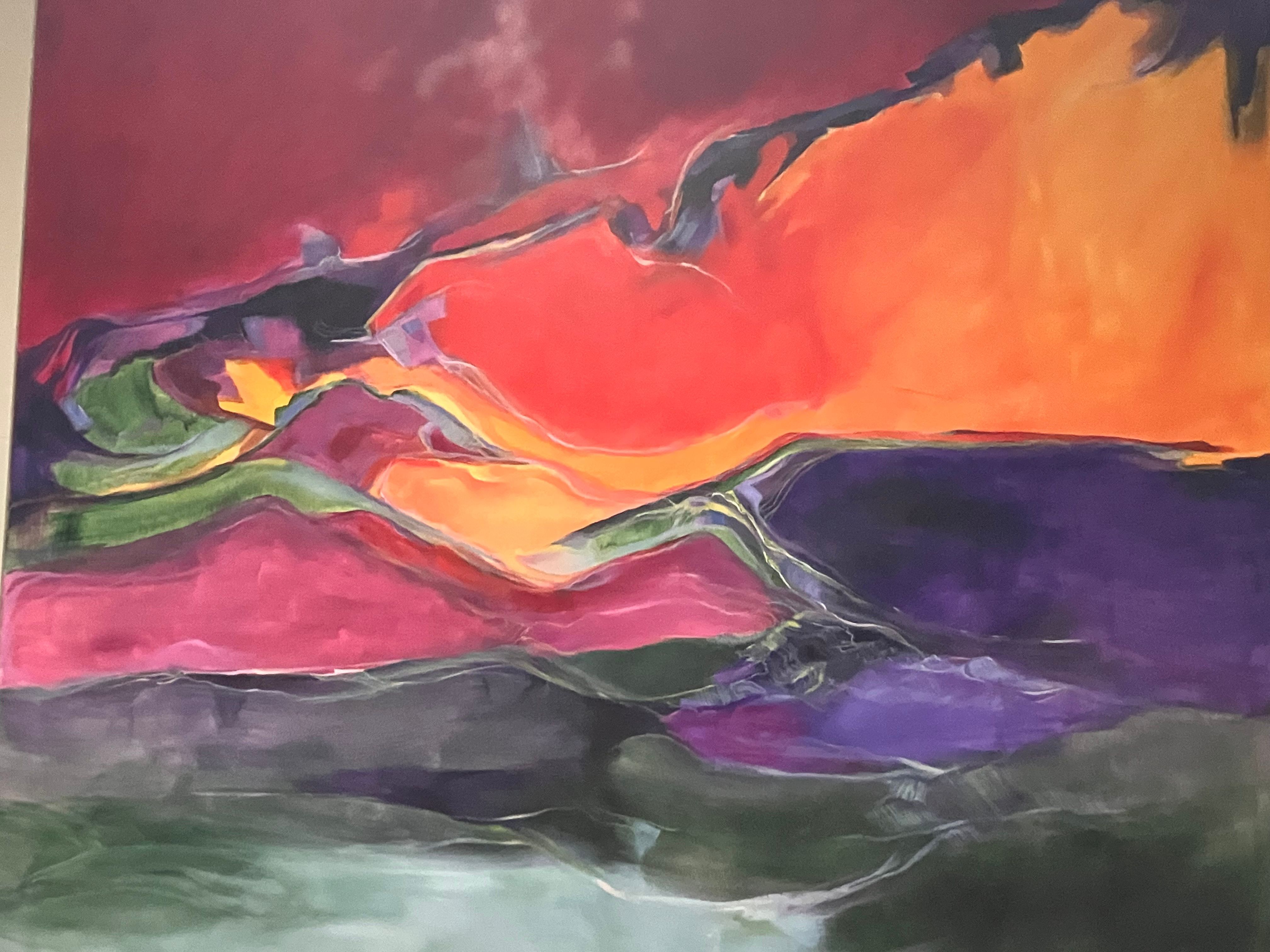
“Is there anything I can do for you?” That was how Dr. Bob ended every conversation. He said it to his wife and his daughters, to patients he had known for thirty years. In September, at eighty-eight, he asked it for the last time, of the people caring for him. We expect there was a crowd, a horse and a few dogs waiting for him on the other side. The painted skies across Texas look like his brushstrokes now.
Robert Floyd Ezell, “Dr. Bob,” of Sugar Land, Texas, was born in Dallas and raised in Fort Worth, the second of six children of Royce Hansel “Bill” Ezell and Bertie Lee, a seamstress. His father ran forty-six years of Texas & Pacific track as a locomotive engineer and liked to tell people he was one of the engineers on the T&P 610. Bob rode a pinto named Tonto to school in 1949 and never stopped talking about it.
His parents asked him to be the oldest, and he took it as an honor. For the next eighty-five years, his brothers and sisters could count on him. Art came easily to him. Medicine was what he meant to do, and he said so all his life. But the scholarships that came his way were for art, so that was the road he took, and he took it seriously. He earned his bachelor’s at
North Texas State and stayed on in Denton for a master’s in art, teaching design and freshman art as a fellow while he worked through his premed courses. His thesis was on medical illustration and a guidance program for students hoping to get from art into medicine, a map he drew for other people before he walked it himself.
He started medical school at twenty-eight and graduated from Indiana University in 1970, by which time there were three daughters, one born in premed, one in medical school, one in residency. Shirley supported him through all of it.
He had met her at North Texas, teaching down the same hall. She had her doctorate in textile chemistry before he had his medical degree, which made them Mr. and Dr. Ezell for the better part of ten years, a fact he happily volunteered to strangers. She did not stop working for any of it, and went on to be Vice President for Academic Affairs at the University of Houston. He called her the most accomplished person he ever met, and he meant it as a fact. They had sixty-three years. He spent them telling people about her. She spent them dancing with him. They kissed hello and goodbye and held hands in between: in the car, at the kitchen table, and in front of anyone who happened to be standing there. Their's was an enduring love that will last forever.
He was among the first class of the new family practice residency at Memorial Hospital in Houston and finished it as chief resident. In 1973, he joined Drs. Crocker and Haley in their Family Medicine Clinic on the Southwest Freeway, where he stayed for the rest of his working life. He was up at five most mornings to reach the doctors’ lounge before rounds. He delivered hundreds of babies. He made house calls for decades after the rest of medicine had quietly stopped, and was occasionally paid in tamales, which he gladly accepted.
He was an extraordinary diagnostician and saved lives and the reason was not cleverness.
It was that he listened, to the patient, to the story, to the small detail everyone else had walked past. People drove a long way to sit across from him, some of them carrying folders from doctors who had not found it. He would hear the whole thing out, including the parts that were not about the illness, and then say the plain thing nobody had said yet. What they
remembered afterward was rarely the diagnosis. It was that someone had finally sat down. One family named a daughter after him.
His colleagues thought well of him too, and said so the way doctors do. They elected him Chief of Staff of Memorial Hermann Southwest in 1992. He was on its active staff for forty years and twice chaired its department of family medicine. He led the Houston Academy of Family Physicians and sat a decade on the board of Memorial HealthNet. For twenty-four years he was a Clinical Professor of Family Medicine at the University of Texas
Medical School.
Nurses and residents still talk about his hands, how gentle he was with a needle. He hugged his patients. They still tell us the same thing: “Your dad taught me everything I know.” Over forty years he showed hundreds of them how to be with a frightened person, and they are doing it today in rooms he never entered, for patients he never met. He was teaching it at the end, to the people who had come to look after him. He was blessed with the help of Walter, Carolina, Hunter and Bladimir, and devoted to his nurse Tracey of more than twenty years.
Bob was an artist all his life, and clear-eyed about the two halves of himself. “I moved from right to left brain activity,” he told an interviewer in 1993. “I guess I am one of the people who used both sides for my two different endeavors. Believe it or not, I can actually feel the shift.” He worked in watercolor and acrylic, contemporary and abstract, landscape and figures,
in bright color, and he was extraordinarily fast.
He showed the work, too. In 1993 he hung eleven paintings in the lobby of Southern National Bank; a hundred and fifty people came to the opening, the show stayed up for weeks, and he did it twice, with a third in discussion. He designed the invitation himself and signed it in the corner, REzell. He gave a painting to the Memorial Foundation gala. He illustrated a medical textbook for the family practice residency program that went on to be used nationally, and for years he drew for The Physician’s Newsletter at Memorial Hospital Southwest, which he helped start and edit. He and Shirley collected the work of young artists, along with Native American and African art, until there was scarcely a wall left in the house. And he drew
horses on everything he ever touched: charts, prescription pads, envelopes, napkins. If you find a napkin of his in a drawer, there is a horse on it.
He did not boast. That he saved for Shirley, and for the horse. But he knew perfectly well he was good at nearly everything he turned his hand to, and considered the matter closed. Whenever a reporter asked, he ranked the art second. His family would like the record to show otherwise. He gave the work away, and much of it is still up. There is a painting at the
country club in The Woodlands, another at Deer Valley Ranch, another at Pecan Grove Baptist Church, and at The Woodlands First Baptist Church a drawing of his that was used for the service.
His paintings lined the office walls. A patient came in one day in the middle of a crisis, and Bob sat with him until he was calm. On his way out the man looked up at one of them and said, “This desire to make something beautiful is the piece of God inside of you.” For Bob the two were never separate. As a boy he stood in front of the congregation and drew in chalk while the choir sang. He taught Sunday school and served as a deacon, and he helped
start two churches, in The Woodlands and Pecan Grove, designing the stained-glass windows and painting the sets for the Christmas pageants, doing with his hands the part of worship he knew how to do.
To his daughters he was a teacher, a friend, and a bear hug. He rocked them in a rocking chair. He danced them around the room, letting them stand on his feet while he twirled them. He taught them color and light, and all three of them studied art in college. In the art class he ran for children he treated his own exactly like the rest, and he once sat them all down in a park and had them draw trees. He praised them constantly, but he never gave a compliment he did not mean, and he could stand over a child’s painting and name every single thing that was working in it. He was the maternal one, affectionate, certain out loud that each of them could be anything she wanted to be, and he never told them no. Shirley painted too, and made jewelry, and sold what she made, which he took as proof that she was the more talented of the two of them. He meant that as well.
His own father had been away on the road, and his daughters grew up with a version of the same thing, because he loved his work and sometimes it came first. He once spent an afternoon helping one of them decorate a bicycle for a Fourth of July parade, and then the call to deliver a baby came and they missed the parade. That happened a lot. But he turned up for the rest of it: ice skating, gymnastics, soccer, drill team, band, always arriving
in the green Plymouth Volaré station wagon with the wood paneling.
The family had one holiday that never changed. They drove to Fort Worth for Christmas with the Ezells at his parents’ farm, then on to Deer Valley Ranch near Monarch Pass in Colorado, where the girls learned to ski while Shirley took up après. Nearly every other vacation was a medical conference, including one in Estes Park at which the doctors’ children were seated in a circle and invited to discuss how difficult it was to be the child of a doctor. Every August he and Shirley went to Indian Market in Santa Fe. They collected Southwest Native art for decades and gave to scholarships for Native students and artists.
He had been of service way long before anyone handed him a white coat. In his fraternity, Sigma Phi Epsilon, he and his friend Richard were the two who did not drink, which made them the two who knew where everybody was. They saw to it that anyone who had had too much got water, a place to lie down, and a ride home with both his shoes on. He and Richard, and their wives Shirley and Mary, talked nearly every day for the next sixty years.
He could keep anything alive, too. People handed him things half dead in pots and he had them flowering by spring. He was patient with every person he ever met and had no patience whatsoever with time. He was a voracious reader and he kept poetry, took French, and played the guitar. He loved Bocelli and “Bridge Over Troubled Water,” hamburgers and coconut pie, horses, mountains, and the light coming through a curtain at four in the afternoon.
We told him that he was the man who loved the most, and that what he taught us was love. He laughed every time, and he believed us. He was always the one who showed up when you needed it most, and at the end others showed up for him, a kindness he had spent a
lifetime giving away.
He is survived by his wife of sixty-three years, Shirley; his daughters Andrea, Cambrea, and Christina; his grandchildren Cullen and Ava; his daughter-in-law Robin; his sons-in-law Greg and Sean; his siblings, Peggie (Marvin) Herring of Aledo, Texas, Linda Neilson of Williamsburg, Virginia, Ronnie “Buddy” (Viola) Ezell of Chama, New Mexico, and Cindy (Larry) Thebeau of La Vernia, Texas; and more nieces, nephews, cousins, colleagues and patients than this space will hold. His parents and his older brother, Royce went on ahead of him.
A memorial service will be held at one o’clock in the afternoon on Friday, November 6, 2026, in Hankamer Chapel at Second Baptist Church, 6400 Woodway Drive, Houston, Texas 77057.
Come if you can. And if you want to do something for him, ask somebody
how they are and wait for the answer.
Art was his talent. Medicine was his purpose. Shirley was his love.
Événements

Créez une page d’événement pour coordonner un rassemblement pour rendre hommage à Robert
Hommages
Partagez un souvenir précieux, offrez vos condoléances et rendez hommage à Robert avec un message rempli de cœur.
Droit d’auteur © 2026 Birdsong Cremations, Tous droits réservés